High above us in its ivory tower the Fed claims the ability to see what lies over the horizon, allowing it to dial-up just the right interest rate to steer our economy to a safe harbor. For eight years the Fed has dialed up the same interest rate of 0% and we are no closer to safe harbor than when we started. Which begs the question. Is the Fed actually in an ivory tower; or is it wandering around in a desert, riding its 0% interest rate camel toward the mirage of a robust economy that’s always disappearing right in front of its eyes?
I think the second scenario is what is actually happening. If the geniuses at The Fed don’t think our economy can handle a quarter point increase in the interest rate, what does that tell us about the strength of our economy. If they want to see what is causing our economic problems they need to look no farther than their zero percent interest rate policy. It is the cause and the effect of the problem.
JEFF DEIST: IN THRALL OF THE FEDERAL RESERVE
In his short article titled, In Thrall Of The Federal Reserve, Jeff Deist covers a lot of ground about the economic reality concerning the Feds zero percent interest rate policy. Here are some excerpts.
“Perhaps no economic pronouncement in history has been anticipated, discussed, predicted, dissected, and reported like the Federal Reserve’s momentous decision today not to raise interest rates..”
“This is not to say the hype is unwarranted. On the contrary, the decision to raise interest rates even just 25 basis points would have represented nothing less than the end of an era…”
“After so many years of the “new normal”, we have to be reminded just how extraordinary – and unprecedented – the Fed’s actions since 2008 have been…..these actions have set America on a hopelessly dangerous and unsustainable path…… placing so much economic power in the hands of a select few might not end well.”
“In The Theory of Money and Credit, Ludwig von Mises made the case more than 100 years ago – before the Fed ever existed – that monetary interventions cannot create prosperity:”
Mises -“Attempts to carry our economic reforms from the monetary side can never amount to anything but an artificial stimulation of economic activity by an expansion of the circulation, and this , as must constantly be emphasized, must necessarily lead to crises and depression. Recurring economic crises are nothing but the consequences of attempts, despite all the teachings of experience and all the warnings of the economists, to stimulate economic activity by means of additional credit.”
The battle between upstart competitor Uber and the monopoly held by the taxi cartel isn’t anything new. Around 1915, owner operated taxi services called ‘jitneys’, fought this battle against the government created rail transportation monopoly. The rise of Uber and their battle with the taxi cartel reminded me of something I read in Thomas Sowell’s book Knowledge and Decisions, published in 1980. (Everyone should read this book.) In the chapter, Trends in Economics, Dr. Sowell talks about “forcibly changing costs” through government regulation. Here are his words. Does this sounds eerily similar to what Uber is doing?
“The history of American transportation, from municipal bus and street lines to railroads and airlines is a history of government – imposed cross-subsidies. Initially, municipal transit was privately owned by a number of firms operating streetcars along various routes. The creation of city-wide franchises – monopolies – was usually accompanied by fixed fares, regardless of distance traveled or transfers required. “
“When a price is simply made higher by government fiat…it conveys a false picture of the “society”, thereby causing potential consumers to forego the product even though others are perfectly willing to supply it for a price that they are willing to pay.”
“Like most price discriminators, municipal transit was vulnerable to competitors who chose to serve the overcharged segment of their customers. Around 1914-1915, the mass production of the automobile led to the rise of owner-operated bus and taxi services costing five cents and therefore called “jitneys” the current slang for nickles:”
“The jitneys were owner-operated vehicles which essentially provided a competitive market in urban transportation with the usual characteristics of rapid entry and exit, quick adaptation to changes in demand, and, in particular, excellent adaptation to peak load demands. Some 60 percent of the jitneymen were part-time operators, many of whom simply carried passengers for nickel on trips between home and work. Consequently, cities were crisscrossed with an infinity of home-to-work routes every rush hour.
The jitneys were put down in every American city to protect the street railways and, in particular, to perpetuate the cross-subsidization of the street railways city-wide fare structures. As a result, the public moved to automobiles as private rather than common carriers…”
“The rush-hour traffic congestion caused by thousands of people going to work separately in individual automobiles has been denounced by social critics as “irrational” and explained by some mysterious psychological attraction of Americans to automobiles. It is, however, a perfectly rational response to the incentives and constraints conveyed. The actual costs and benefits of automobile-sharing are forcibly prevented from being conveyed by prices. As in other areas, claims of public irrationality are a prelude to arguments for a government-imposed “solution” to the “problem”. As in other areas, it is precisely the government’s use of force to prevent the accurate transmission of knowledge through prices that leads to the suboptimal systemic results which are articulated as irrational intentional results of a personified “society”.”
“…maintenance of incumbent transportation entities, often implies the maintenance of incumbent technologies ie., subsidized obsolescence, resisting the phasing out of existing modes of operation, as competing modes arise…..competing modes with technological or organizational advantages are either penalized or prohibited (as in the case of the jitneys), to preserve incumbent organizations and technology.”
MONOPOLIES CAN’T EXIST WITHOUT GOVERNMENT SANCTION
Uber is the modern-day version of the jitneys from 100 years ago. The taxi cartel is the protected “incumbent transportation entity”. The street rail system couldn’t foresee a competitor until a new technology, the automobile, came into existence, just as the taxi cartel couldn’t foresee a competitor until a ride sharing app came into existence. Government created monopolies look to government for help in stifling competition. When a business begins to expand because they win a larger share of the market, its efforts turn away from serving customers and toward protecting their market position. They lobby government to pass regulations making it more difficult, if not illegal, for competitors to enter the market. The combination of big business and big government is toxic to the economy and consumers.
FREE MARKETS OR CENTRAL PLANNING
In this article, Once A Sure Bet, Taxi Medallions Becoming Unsellable, there is a video of a Chicago taxi driver complaining about Uber drivers not having to jump through all the government hoops that taxi drivers have to jump through to be licensed to drive people around. He doesn’t realize that he is actually making the case against government intervention into the taxi industry. Starting with the price of the taxi medallion and going through all the other costly regulations is an indictment of government, not Uber.
This article, Major Trouble For Uber In California, is an example of governments trying to regulate Uber, at the cost of the consumer. Politicians and bureaucrats don’t understand that a free market creates the incentive for businesses to provide great service, or the consumer has an option of going to a competitor. Under a government created monopoly system the business has no incentive to provide great service for the consumer, because there are no competitors, (Think DMV) read this article, Uber vs Big Taxi: Time To Resolve Driver Complaints – Seconds/Days vs. Years.
The consumer pays a higher price because the supply of cabs is limited to the amount of medallions issued by the government. In a free market supply and demand coordinates the number of cab drivers and passengers at a particular price. Allowing the price to change, allows supply and demand to be continually coordinated according to the changing values of demanders and suppliers.
HOW UBER WORKS
The ride sharing Genie is out of the proverbial bottle. Governments can’t stop it. With how quickly technology changes, don’t be surprised if something different comes along that will challenge Uber as the most cost effective way of transporting people from one place to another. Can you say, “Beam me up Scottie”?
The Frasier Institute has come up with a project called Essential Hayek (here). It consists of a book, a website, and videos, that explain F.A. Hayeks ideas on liberty and economics in simple understandable language.
I remember reading The Road To Serfdom by F. A. Hayek in September of 1994. I don’t think I comprehended a quarter of the book at the time, but what I did comprehend opened my eyes to the fact that the US was traveling down this road rapidly. I have reread this book several times and have also read The Constitution of Liberty, all three volumes of Law Legislation and Liberty, The Fatal Conceit, Prices and Production, A Tiger By The Tail, Individualism and Economic Order, and many of his articles and essays.
When you first read Hayek he is not easy to understand because he was writing about abstract concepts and his native tongue was German. As you start to know his writing style, which includes the lengthy sentences he constructs, he becames much easier to comprehend.
Here are two short videos from Essential Hayek.
Economic Booms And Busts
Everything Has Its Price (And That’s A Good Thing)
My Favorite Hayek Quote, is at the top right of my blog.
“The coordination of men’s activities through central planning or through voluntary cooperation are roads going in very different directions. The first to serfdom and poverty the second to freedom and plenty.”
Volumes have been written explaining this quote, or these two sentences explain volumes of writings.
Spontaneous Order
The spontaneous order of the market far exceeds coordination through central planning, in the use of knowledge, the use of scarce resources, the creation of a higher standard of living. If you don’t understand the concept of spontaneous order it will be difficult to understand how the world works.
F. A. Hayek—” The free market pricing mechanism has a double misfortune. It is not the product of human design, and the people guided by it usually do not know why they are made to do what they do.”
Here are some related articles about spontaneous order.
In this article titled, You Can’t Create More Savings By Printing More Money, Frank Shostak (mises.org) shows us that what you produce is actually what you can consume or exchange for something that you haven’t produced but want to consume. What you don’t consume or exchange is what you save. Savings is real production. Money is what we use to make the exchange process easier. Money is how we figure out exchange ratios between goods and services. Exchange ratios represented by prices in money is how 1 gallon of gas costing 2$ can be exchanged for two 1$ candy bars, or four 50 cent news papers, without ever exchanging the actual goods. Printing money isn’t the creation of any good of service. It is the creation of the demand for a good or service that is not backed by actual production. Printing money is theft.
Here are some excerpts from the article.
“Savings has nothing to do with money. For instance, if a baker produces ten loaves of bread and consumes one loaf, his savings is nine loaves of bread. In other words, the “savings” in this case is the baker’s real income (his production of bread) minus the amount of bread that the baker consumed.”
“When a baker sells his bread for money to a shoemaker, he has supplied the shoemaker with his saved, unconsumed bread. The supplied bread sustains the shoemaker and allows him to continue making shoes. Note that the money received by the baker is fully backed by his unconsumed production of bread.”
“Money can be seen as a receipt, as it were, given to producers of final goods and services that are ready for human consumption. Thus when a baker exchanges his money for apples, the baker has already paid for them with the bread produced and saved prior to this exchange. Money therefore is the baker’s claim on real savings. It is not, however, savings.”
“The printing of money therefore cannot result in more savings as suggested by mainstream economists, but rather to its redistribution”
“…. savings is not about money as such, but about final goods and services that support various individuals that are engaged in various stages of production. It is not money that funds economic activity but the flow of final consumer goods and services. The existence of money only facilitates the flow of the real stuff.”
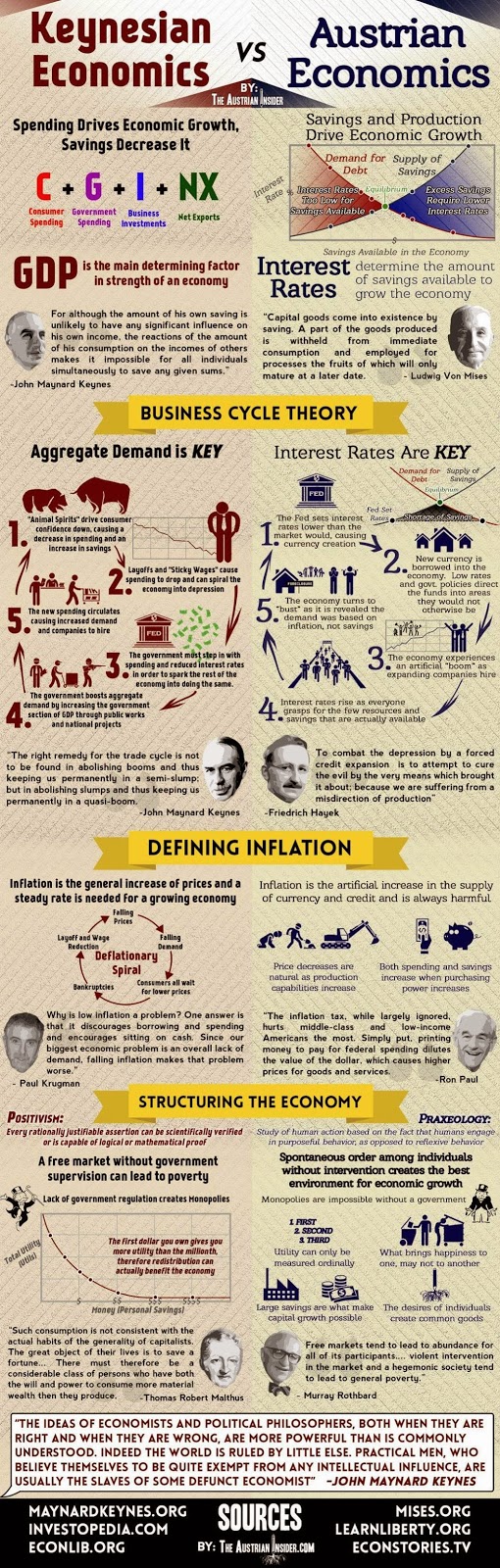
This infographic is from The Austrian Insider (click here). It gives a short outline of the differences between Keynesian Economics and Austrian Economics.
I’ve previously posted these two rap videos about Keynesian Economics vs The Austrian School, featuring F.A. Hayek vs. J.M. Keynes. Listen closely to the arguments from both sides, I forgot how well these were put together.
FEAR THE BOOM AND BUST: KEYNES vs. HAYEK
THE FIGHT OF THE CENTURY: KEYNES vs. HAYEK ROUND II
These are by John Papola and Russ Roberts from Econ Stories.
Go to The Ludwig von Mises Institute at mises.org for more information about the Austrian perspective.
The left always comes up with words or phrases that ridicule the ideas and/or policies of their opponents with the intent of stopping any intelligent debate about the merits. In the 80’s, the policy of lowering tax rates for the purpose of economic growth, was called “trickle down economics” by the left in an attempt to convince shallow thinking people that this idea couldn’t possibly work. The term “trickle down” has been used by the left since the 80’s to torpedo any economic policy, especially tax cuts.
HILLARY: ECONOMIST EXTRAORDINAIRE
Here is Hillary Clinton using this tactic in a speech yesterday (10/24/14) at a campaign rally for Martha Coakly. At the start of this short video she says, “…don’t let anybody tell you that, you know, it’s corporations and businesses that create jobs.”, which is similar to the President saying, “..if you got a business, you didn’t build that“, in a campaign speech from the 2012. Mrs. Clinton’s statement reveals either her total ignorance about economics, or her great insight into the economic ignorance of the audience. We could write a post answering this statement, but it’s the next line; “You know that old theory, trickle down economics. That has been tried. That has failed. That has failed rather spectacularly.”, that this post will be about.
THOMAS SOWELL AND WALTER E. WILLIAMS SPEAK ABOUT “TRICKLE DOWN”
Economist Thomas Sowell has challenged anyone to name an economist from any economic school of thought who had actually advocated a “trickle down theory”. In this article from 2001, Capital Gains And Trickle Down, he states that there is no such thing as “trickle down theory”. The left uses the term to attack tax cuts by saying, their opponents want tax cuts that will help the rich first and the money will supposedly trickle down to the masses. So just to be clear they are saying that letting everybody keep more of what they produce by reducing tax rates is a “trickle down theory”. This theory they created is simply a straw man.
Economist Walter E. Williams talks about the fake war that has been fought against the “Trickle Down” straw man in this article, Trickle Down And Tax Cuts. This is a tactic used by all politicians in which they misrepresent (lie about) an opponents idea or policy, setting up a straw man, in order to argue against this false premise instead of debating their opponent head on. In this case the left sets up the “Trickle Down” straw man to try to win the tax cut argument.
These two articles are really great especially the examples they give. Here are some excerpts from Thomas Sowell’s article.
“But free-market economics is not about “distributing” anything to anybody. It is about letting people earn whatever they can from voluntary transactions with other people.”
“Those who imagine that profits first benefit business owners — and that benefits only belatedly trickle down to workers — have the sequence completely backward. When an investment is made, whether to build a railroad or to open a new restaurant, the first money is spent hiring people to do the work. Without that, nothing happens.”
“Money goes out first to pay expenses and then comes back as profits later — if at all. The high rate of failure of new businesses makes painfully clear that there is nothing inevitable about the money coming back.”
” No one who begins publishing a newspaper expects to break even — much less make a profit — during the first year or two. But reporters and other members of the newspaper staff expect to be paid every payday, even while the paper shows only red ink on the bottom line.”
“In short, the sequence of payments is directly the opposite of what is assumed by those who talk about a “trickle-down” theory.”
Here are some excerpts from Walter E. Williams article.
“Trickle down is a nonexistent theory. Those who use it simply argue against a caricature rather than confront an argument actually made.”
“You can bet that the White House has people reading every bit of the news, including this column and Dr. Sowell’s article. You can bet some people in the news media will read it, as well. Despite the facts that Sowell has marshaled, they will continue to use trickle down theory and “tax cuts for the rich” demagoguery, even though they now have hard evidence to the contrary, because they can count on widespread gullibility and inability to do critical thinking.”
THE FEDS MONETARY POLICY, IS THE TRICKLE DOWN STRAW MAN
Getting money in the hands of the rich with the idea that it will trickle down through the rest of the economy is the straw man the left says won’t work. They are correct. The Feds loose money policy since 2000 is proof that it doesn’t work. Instead of letting individuals keep what they produce by lowering taxes, the Fed electronically prints counterfeit money and gives it to the top 1%. The Fed has printed a total of $7 trillion since 2000 (click here) with $4 trillion of that being printed since 2008. Click here to see what has happened to the real median household income since this counterfeiting started before 2000. It has gone down.
The Fed injects electronically printed counterfeited money into the economy by purchasing mortgage-backed securities, from banks, and treasury bonds, from the Federal Government. The banks and the Federal Government have first access to the counterfeit money. Everyone in the immediate orbit of the banks and the Federal Government benefit secondarily from this printed money, you and I don’t benefit. Look at the charts in this article, Abolish The Engine Of Inequality: The Federal Reserve, by Charles Hugh Smith. They show that the income and wealth of the people with access to the Feds counterfeit money has grown. And the wealth of the rest of us is stagnant or shrinking. The more the Fed prints the bigger the gap.
CONCLUSION
The Feds experiment of giving their counterfeit money to the people at the top and hoping it will trickle down has been going on since before the tech bubble popped in 2000. The tech bubble lead to the housing bubble that popped in 2008, which lead to the current financial bubble that will eventually liquidate itself at some point. The counterfeiting by the Fed created these bubbles in the first place. In the words of economist extraordinaire Hillary Clinton, “It has failed rather spectacularly“. She is correct. Trickle down economic theory defined by the left, as giving money to the wealthy in the hopes that it will trickle down, doesn’t work. Unless the goal was to make the first receivers of the money wealthier at the expense of the rest of us. But who could possibly be cynical enough to think that?
I like reading economic articles by Richard Ebeling. He explains abstract economic concepts in ways that are understandable for regular people. Although we have written about these concepts in the past, we can always gain greater insight by reading different explanations by different writers. Even if you understand these economic concepts, this article may help when you try to explain them to people who don’t have the same level of understanding.
KEYNES LEAKS THE TRUTH ABOUT DEBASING THE CURRENCY
As John Maynard Keynes said, “There is no subtler, no surer means of overturning the existing basis of society than to debauch the currency. The process engages all the hidden forces of economic law on the side of destruction, and does it in a manner which not one man in a million is able to diagnose.”
The only way Central Banks have gotten away with electronically printing counterfeiting money is because it is difficult to understand. Our job is to shrink that one in a million ratio, because the only way our current problems change is if more people truly understand what results when the Fed intervenes in the market.
RICHARD EBELING ARTICLE
The article, Ludwig von Mises And The Austrian Theory Of Inflations And Recessions, by Richard Ebeling, at epictimes.com, explains, 1) How money emerges from markets not Government, 2) Saving and investment, 3) How central banks cause business cycles, 4) Inflation and misallocated resources, 5) Recession corrects the Fed caused misallocations.
Here are some excerpts from the article.
“Money is a market-based and market-generated social institution that spontaneously emerges out of the interactions of people attempting to overcome the hindrances and difficulties of direct barter exchange……Historically, gold and silver were found through time to have those attributes most desirable for use as a medium of exchange to facilitate the ever-growing network of complex market transactions that enabled the development of an ever-more productive system of division of labor.”
“Like all other prices on the market, the rates of interest on loans coordinate the choices of savers with the decisions of borrowers so to keep supplies in balance with demands for either consumer goods or future-oriented investment goods.”
“An economic recession, therefore, is the discovery period of misallocations of scarce resources in the economy that requires a rebalancing and a recoordination of supplies and demands for a return to market- and competitively-determined harmony in the society’s economic activities for long-run growth, employment, and improved standards of living.”
Federal Reserve Policies Cause Booms And Busts (read here at mises.org), is a fantastic article by Richard M. Ebeling, explaining what happens when central banks, like the Fed, intervene in the economy. Electronically printing counterfeit money and artificially lowering interest rates are the tools the Fed uses to “improve” the economy. The Fed may pay lip service to the free market, but the policy makers at the Fed truly don’t like the outcome resulting from the voluntary decisions individuals make in the free market. If they did, they wouldn’t intervene after the fact to try to exchange what they want the economy to look like, for what actually exists as a result of what each individual decides to produce, consume, save, and exchange.
Their tools of intervention, electronically printing counterfeit money and artificially lowering interest rates, send false information through the market. People in the market start to make decisions on what to produce, consume, save, and exchange based on this false information. The structure of the production process has no anchor to reality and the result is distortions and malinvestment. Scarce resources are allocated to areas of the economy that can’t be sustained unless ever-increasing amounts of electronically printed counterfeit money is pushed into the economy. The economic forces of supply and demand are always trying to reach equilibrium (balance). These economic forces, that are trying to correct the interventions of the central planners, will eventually win.
HERE ARE SOME EXCERPTS FROM THE ARTICLE
“In the free market, interest rates perform the same functions as all other prices: to provide information to market participants; to serve as an incentive mechanism for buyers and sellers; and to bring market supply and demand into balance. Market prices convey information about what goods consumers want and what it would cost for producers to bring those goods to the market.”
“Market rates of interest balance the actions and decisions of borrowers (investors) and lenders (savers) just as the prices of shoes, hats, or bananas balance the activities of the suppliers and demanders of those goods...”
“…There is one crucial difference, however, between the price of any other good that is pushed below that balancing point and interest rates being set below that point. If the price of hats, for example, is below the balancing point, the result is a shortage;”
“…In contrast, in the market for borrowing and lending the Federal Reserve pushes interest rates below the point at which the market would have set them by increasing the supply of money on the loan market. Even though savers are not willing to supply more of their income for investors to borrow, the central bank provides the required funds by creating them out of thin air and making them available to banks for loans to investors. Investment spending now exceeds the amount of savings available to support the projects undertaken”
“…The twin result of the Federal Reserve’s increase in the money supply……is an emerging price inflation and an initial investment boom…”
“…The boom is unsustainable because the imbalance between savings and investment will eventually necessitate a market correction when it is discovered that the resources available are not enough to produce all the consumer goods people want to buy, as well as all the investment projects borrowers have begun.”
“Interest rates, like market prices in general, cannot tell the truth about real supply and demand conditions when governments and their central banks prevent them from doing their job. All that government produces from its interventions, regulations, and manipulations is false signals and bad information. And all of us suffer from this abridgement of our right to freedom of speech to talk honestly to each other through the competitive communication of market prices and interest rates, without governments and central banks getting in the way.“
In this article, Why Has Classical Capitalism Devolved Into Crony-Capitalism, Charles Hugh Smith, (oftowminds.com) makes the point that the Elites, consisting of ; people in Government and central bankers, lesser institutions that are closest in orbit around Government and central banks, and organizations and individuals who are orbiting these lesser institutions, think the economy will eventually “heal itself” even after all they have stolen through zero percent interest rates, electronically printed counterfeit money, and Government debt. These three legs of theft are, quoting CHS, “…crippling the market’s self-healing immune system: Price discovery. Thanks to ceaseless interventions by central banks, the price discovery mechanism has been shattered: want to know the price of risk? It’s near-zero. Yield on sovereign bonds? Near-zero. And so on. Prices have been so distorted (the ultimate goal of Central Planning everywhere, from China to the EU to Japan to the U.S.) that the illusion of stability is impossible without more intervention.”
Here are his six factors of how, “...free market capitalism becomes state-cartel crony-capitalism, a Ponzi scheme of epic proportion...”
1. “Those who control most of the wealth are willing to risk systemic collapse to retain their privileges and wealth. Due to humanity’s virtuosity with rationalization, those at the top always find ways to justify policies that maintain their dominance and downplay the distortions the policies generate. This as true in China as it is in the U.S.”
2. “Short-term thinking: if we fudge the numbers, lower interest rates, etc. today, we (politicians, policy-makers, money managers, etc.) will avoid being sacked tomorrow. The longer term consequences of these politically expedient policies are ignored.”
3. “Legitimate capital accumulation has become more difficult and risky than buying political favors. Global competition and the exhaustion of developed-world consumers has made it difficult to reap outsized profits from legitimate enterprise. In terms of return-on-investment (ROI), buying political favors is far lower risk and generates much higher returns than expanding production or risking investment in R&D.”
4. “The centralization of state/central bank power has increased the leverage of political contributions/lobbying. The greater the concentration of power, the more attractive it is to sociopaths and those seeking to buy state subsidies, sweetheart contracts, protection from competition, etc.”
5. “Any legitimate reform will require dismantling crony-capitalist/state-cartel arrangements. Since that would hurt those at the top of the wealth/power pyramid, reform is politically impossible.”
6. “Understood in this light, it’s clear that central bank monetary policy—zero-interest rates, asset purchases, cheap credit to banks and financiers, QE, etc.—is designed to paper over the structural problems that require real reform.”
CHARLES HUGH SMITH INTERVIEW
If you want to hear an interesting and in-depth explanation about the rise of crony capitalism, listening to Charles Hugh Smith’s interview with Gordon T. Long would be well worth your time ( it also has some great graphs and diagrams).
Understanding the role capital goods play in an economy is important, but understanding the process of producing capital goods is more important. Using capital goods allows individuals to become more productive over time. Capital goods are scarce, they don’t magically appear. Present consumption has to be foregone to save the resources and time needed to produce capital goods. The foundation of the advance in the worlds material standard of living is due to the capital structure that has evolved over time. The two articles below explain Capital Theory using analogies that are simple to understand. The first by Mark Tovey is from this week, and the second is by Robert P. Murphy and is from Oct. 2008, which was in the middle of the economic crisis.
“The adoption of ever-more roundabout and convoluted production processes is, paradoxically, the hallmark of economic development. This is not, of course, because time-consuming methods are inherently more productive. If that were the case, we could increase output by simply working more slowly!…..roundabout methods are immensely more productive than their labor-intensive counterparts, hence it is why the more complex methods have come to replace the labor-intensive ones in the developed human economies of the world.”
“In the process of economic growth, saving is crucial. No matter how ingenious the individuals comprising a society, if the means to forgo present consumption are unavailable, capital goods simply cannot be created. Crude, labor-intensive methods of production will then necessarily be employed,”
“The basic Austrian story is that during the artificial boom, workers’ labor and other resources get channeled into investment projects that aren’t compatible with the overall level of real savings. Sooner or later, reality rears its ugly head, and the unsustainable projects have to be abandoned before completion. Entrepreneurs realize they were horribly mistaken during the boom, everybody feels poorer and slashes consumption, and many workers get thrown out of jobs until the production structure can be reconfigured in light of the revelation.”
“As our simple story illustrates, in modern economies workers use capital goods to augment their labor as they transform nature’s gifts into consumption goods. Because of the time structure of production, it is possible to temporarily boost everyone’s consumption (with Government or Fed stimulus), but only at the expense of maintaining the capital goods, which are thus “consumed.” At some point, engineering reality sets in, and no “stimulus” policies can prevent a sharp drop in consumption.”
"THE COORDINATION OF MENS ACTIVITIES THROUGH CENTRAL PLANNING OR THROUGH VOLUNTARY COOPERATION ARE ROADS GOING IN VERY DIFFERENT DIRECTIONS, THE FIRST TO SERFDOM AND POVERTY THE SECOND TO FREEDOM AND PLENTY."
"THERE IS NO SUBTLER, NO SURER MEANS OF OVERTURNING THE EXISTING BASIS OF SOCIETY THAN TO DEBAUCH THE CURRENCY. THE PROCESS ENGAGES ALL THE HIDDEN FORCES OF ECONOMIC LAW ON THE SIDE OF DESTRUCTION, AND DOES IT IN A MANNER WHICH NOT ONE MAN IN A MILLION IS ABLE TO DIAGNOSE."
Most Recent Quote
F.A. Hayek - "Since the value of freedom rests on the opportunity it provides for unforseen and unpredictable actions, we will rarely know what we lose through a particular restriction of freedom."
Quote
Matthew McCaffrey - "Building a freer society means winning the battle of ideas, not the empty contests put on by the central Government every four years. Freedom is never obtained by endorsing the least offensive applicant for the position of chief villain."
Quote
Ludwig von Mises - "The middle system of property that is hampered, guided, and regulated by government is in itself contradictory and illogical. Any attempt to introduce it in earnest must lead to a crisis from which either Socialism or Capitalism alone can emerge."
Quote
F. A. Hayek - "While it may not be difficult to destroy the spontaneous formations which are the indispensable bases of a free civilization. It may be beyond our power deliberately to reconstruct such a civilization once these foundations are destroyed."
Quote
Murray Rothbard - "The market promotes and rewards the skills of production and voluntary cooperation. The Government enterprise promotes the skills of mass coercion and bureaucratic submission...and those who get to the top will be those with the most skill in that particular task."
Quote
John Adams - "Government is instituted for the common good: for the protection, safety, prosperity, and happiness of the people. And not for profit, honor, or private interest of any one man, family, or class of men..."
Quote
Milton Friedman - "Underlying most arguments against the free market is a lack of belief in freedom itself."
Quote
Chris Rossini - "The state is a monster that destroys. Those who gain control of the levers, choose the targets."
Quote
Murray Rothbard -"It is no crime to be ignorant of economics...but it is totally irresponsible to have a loud and vociferous opinion on economic subjects while remaining in this state of ignorance."
Quote
Murray Rothbard -"Democracy can be only a possible route toward a free society rather than an attribute of it. In a purely free society there would be nothing for democratic electors to vote about."
Quote
Robert Bradley Jr. - "When Government tries to pick winners and losers, it typically picks losers. Why? Because the Free market consumers pick winners to leave the losers for Government."
Quote
Benito Mussolini - "Fascism should more appropriately be called corporatism because it is a merger of state and corporate power."
Quote
Ludwig von Mises - "Men must choose between the market economy and socialism....some agency must determine what should be produced. If it is not the consumer by means of demand and supply on the market, it must be the Government by compulsion."
Quote
F. A. Hayek - "The curious task of economics is to demonstrate to men how little they really know, about what they imagine they can design."
Quote
Detlev Schlichter - "Any intervention in the market (by the state) must direct resources away from how private owners would have employed them and toward how state officials and their economic advisers would like to see them employed."
Quote
Henry Hazlitt - "The question is not whether we wish to see everybody as well off as possible....the real question concerns the proper means of achieving it. And in trying to answer this we must never lose sight of a few elementary truisms. We cannot distribute more wealth than is created. We cannot in the long run pay labor as a whole more than it produces."
Quote
Murray Rothbard - "Whether or not man lives at the level of poverty or abundance depends upon the success that he and his ancestors have had in grappling with nature and in transforming naturally given resources into capital goods and consumers goods.... Free markets tend to lead to abundance for all of its participants.... violent intervention in the market and a hegemonic society tend to lead to general poverty."
Quote
Ludwig von Mises - "Inflation and credit expansion are the means to obfuscate the fact that there prevails a nature-given scarcity of the material things on which the satisfaction of human wants depends. The main concern of capitalists private enterprise it to remove this scarcity as much as possible and to provide a continuously improving standard of living for an increasing population.....but however remarkable these improvements may be, there will always be a strict limit to the amount that can be consumed without reducing the capital available for the continuation and, even more, the expansion of production."
Quote
Ludwig von Mises - " It is impossible to grasp the meaning of the idea of sound money if one does not realize that it was devised as an instrument for the protection of civil liberties against despotic inroads on the part of Governments. Ideologically, it belongs in the same class with political constitutions and bills of rights."
Quote
Murray Rothbard - "To reduce the working population while the consuming population remains undiminished is to lower the standard of living."
Quote
Murray Rothbard - "Increasing the money supply confers no social benefit. It relieves no economic scarcity. It simply benefits some at the expense of others."
Quote
Ludwig von Mises - "Political ideas that have dominated the public mind for decades cannot be refuted through rational arguments, they must run their course in life and cannot collapse otherwise than in great catastrophe."
Quote
Milton Friedman - "A society that puts equality- in the sense of equality of outcome- ahead of freedom will end up with neither equality nor freedom. The use of force to achieve equality will destroy freedom, and the force introduced for good purposes, will end up in the hands of people who use it to promote their own interests."
Quote
F. A. Hayek - "It has already been suggested that it is not necessary, for the working of this free market capitalist system, that anybody should understand it. But people are not likely to let it work if they do not understand it."
Quote
C. S. Lewis - "Of all tyrannies, a tyranny sincerely exercised for the good of its victims may be the most oppressive. It would be better to live under robber barons than under omnipotent moral busybodies. The robber barons cruelty may sometimes sleep, his cupidity may at some point be satiated; But those who torment us for our own good will torment us without end for they do so with the approval of their own conscience."
Quote
Ludwig von Mises - "For the naive mind there is something miraculous in the issuance of fiat money. A magic word spoken by the Government creates out of nothing a thing which can be exchanged against any merchandize a man would like to get."
Quote
Ludwig von Mises - "Many think that governments are free to achieve all they aim at without being restrained by an inexorable regularity in the sequence of economic phenomena....they maintain that the state is God."
Quote
George Gilder - "Under capitalism, economic power flows not to the intellectual, who manipulates ideas and basks in their light, but to men who gives himself to his ideas and tests them with his own wealth and work."
Quote
Thomas Sowell - "Perhaps the greatest achievement of market economies is in economizing on the amount of knowledge needed to produce a given economic result. That is also their greatest political vulnerability."
Quote
Ludwig von Mises - "Anti capitalistic policies sabotage the operation of the capitalist system of the market economy. The failure of interventionism does not demonstrate the necessity of adopting socialism. It merely exposes the futility of interventionism. All those evils which the self-styled "progressives" interpret as evidence of the failure off capitalism are the outcome of their allegedly beneficial interference with the market."
Quote
F.A. Hayek - "The battle for freedom must be won over and over again, the socialists of all parties must be persuaded or defeated if they and we are to remain free men."
Quote
F. A. Hayek - "Planning, or central direction of economic activity, presupposes the existence of common ideals and common values; and the degree to which planning can be carried is limited to the extent to which agreement on such a common scale of values can be obtained or enforced."
Quote
Thomas Sowell - "In political competition accurate knowledge has no decisive competitive advantage, because what is being sold is not an end result but a plausible belief about a complex process"
Quote
Thomas Sowell - " Taxing away what other people have earned, in order to finance one's own moral adventures via social programs, is often depicted as a humanitarian endeavor, while allowing others the same freedom and dignity as oneself, so that they can make their own choices with their own earnings is considered pandering to greed. Greed for power is no less dangerous than greed for money, and has historically shed far more blood in the process."
Quote
Peter Earle - "In a world of infinate desires and limited means, choices must be made; a study of history and economics reveals that, while markets make no promises, they never lie. The only choice is whether distribution, or redistribution as the case may be, is to be accomplished by the organic, apportioning hand of the price system, or by the corrupt, spoilative claw of states."
Quote
Thomas Jefferson - "....To preserve our independence, we must not let our rulers load us with public debt....we must make our choice between economy and liberty or confusion and servitude....if we run into such debts, we must be taxed in our meat and drink, in our necessities and comforts, in our labor and in our amusements.... if we can prevent the Government from wasting the labor of the people under the pretense of caring for them, they will be happy."
Quote
F. A. Hayek - "The democratic statesman who sets out to plan economic life will soon be confronted with the alternative of either assuming dictatorial powers or abandoning his plans."
Quote
Jean Baptiste Say - "...The encouragement of mere consumption is no benefit to commerce, for the difficulty lies in supplying the means, not in stimulating the desire of consumption; and we have seen that production alone, furnishes those means. Thus, it is the aim of Good Government to stimulate production, of bad Government to encourage consumption."
Quote
Ludwig von Mises - "The middle-of-the-road policy is not an economic system that can last. It is a method for the realization of socialism by installments."
Quote
Thomas Sowell - "What is politically defined as economic planning is the forcible superseding of other people's plans by Government officials."
Quote
Thomas Sowell - "The market is simply the freedom to choose among many existing or still to be created possibilities. The Government establishes an army or a post office as the answer to a given problem.... The diversity of personal tastes insures that no given institution will become the answer to a human problem in the market."
Quote
Thomas Sowell - "Just as a poetic discussion of the weather is not meteorology, so an issuance of moral pronouncements or political creeds about the economy is not economics."
Quote
Paul Craig Roberts - "We should all be thankful to the Soviets, because they have proved conclusively that socialism doesn't work. No one can say they didn't have enough power or enough bureaucracy or enough planners or they didn't go far enough."
Quote
Alexis de Tocqueville - "Democracy extends the sphere of individual freedom, socialism restricts it. Democracy attaches all possible value to each man, socialism makes each man a mere agent, a mere number. Democracy and socialism have nothing in common but one word: equality, but notice the difference: while democracy seeks equality in liberty, socialism seeks equality in restraint and servitude."
Quote
George Gilder - "The Real Issue is between the rule of law and the rule of leveler egalitarianism, between creative excellence and covetous "fairness", between admiration of achievement versus envy and resentment of it'.
Quote
Thomas Jefferson - "The issue today is the same as it has been throughout all history, whether man shall be allowed to govern himself or be ruled by a small elite."
Quote
Judge Leonard Hand - "Liberty lies in the hearts of men and women; if it dies there, no constitution, no law, no court can save it."
Quote
Ludwig von Mises - "Modern civilization is a product of the philosophy of laissez faire, it cannot be preserved under the ideology of Government omnipotence."
Quote
Ludwig von Mises - "The issue is always the same: the government or the market. There is no third solution."
Quote
H.L. Menken - "Government is a broker in pillage, and every election is an advance auction on the sale of stolen goods"
Quote
F.A. Hayek - "Perhaps the fact that we have seen millions voting themselves into complete dependence on a tyrant has made our generation understand that to choose one's Government is not necessarily to secure freedom."
Quote
Detlev Schlichter - "Economics is the science of how we use social institutions such as private property and voluntary exchange on free markets to make the best use of scarce resources. The printing press tries to do away with scarcity."
Quote
Thomas Sowell - "The God like approach to social policy ignores the diversity of values and the cost of agreement among human beings."
Quote
Henry Hazlitt - "Whenever men are allowed liberty, and freedom of choice, they will make mistakes. Liberty is not a guarantee of omniscience. But neither are the mistakes of free men a valid excuse to take away their liberty, and impose Government controls in its stead, on the ground that all wisdom and disinterestedness resides in the people who are going to do the controlling."
Quote
Thomas Sowell - "Nothing is easier than to confuse broader powers with deeper insight. But almost by definition, those with the broadest powers are the most remote from the specific knowledge needed for either deciding, or for knowing, the actual consequences of their decisions."
Quote
Ludwig von Mises - "Credit expansion is the Government's foremost tool in their struggle against the market economy. In their hands it is the magic wand designed to conjure away the scarcity of capital goods, to lower the rate of interest or to abolish it altogether to finance lavish Government spending."
Quote
Ludwig von Mises - "Economic history is a long record of Government policies that failed because they were designed with a bold disregard for the laws of economics."
Quote
Chaderov - "Since the State thrives on what it expropriates, the general decline in production that it induces by it's avarice foretells its own doom. Its source of income dries up. Thus in pulling society down it pulls itself down."
Quote
Thomas Sowell - "If an informed citizenry is the foundation of democratic Government, than an uninformed citizenry is a danger."
Quote
Thomas Sowell - "The free market works best when there is a level playing field but politicians win more votes by tilting the playing field to favor particular groups."
Quote
Thomas Sowell - "However dramatic or attractive a particular vision may be, ultimately everyone must live in the world of reality. To the extent that reality has been filtered to fit a vision, this filtered information is a misleading guide to making decisions in an unforgiving reality, to which we must all adjust because it is not going to adjust to us."
Quote
Thomas Sowell - "Envy was once considered to be one of the seven deadly sins before it became one of the most admired virtues under its new name "Social Justice"."
Quote
Murray Rothbard - "Bureaucracy incompetent enough to plan a stationary system, is vastly more incompetent at planning a progressing one."
Quote
Ludwig von Mises - "Freedom is incompatible with equality of wealth and income. Men are born unequal and it is precisely their inequality that generates social cooperation and civilization."
Quote
Murray Rothbard - "Government subsidy systems promote inefficiency in production and efficiency in coercion and subservience, while penalizing efficiency in production and inefficiency in predation (plundering)."
Quote
Francisco Capella - "The right of property is a negative right of noninterference. Humans do not have natural positive rights that imply that others must do something for them, and there is no natural duties towards others (present and future). Positive rights and duties arise by means of contracts."
Quote
Victor Davis Hanson - "Social justice sees the Government's proper moral obligation not as ensuring equality out of the starting gate, but as guaranteeing that we will all reach the finish line at the same exact moment."
Quote
F.A. Hayek - "A claim for equality of material position can be met only by a Government with totalitarian powers."
Quote
Thomas Sowell - "People who are very aware that they have more knowledge than the average person are often very unaware that they do not have one tenth of the knowledge of all of the average persons put together. In this situation, for the intelligentsia to impose their notions on ordinary people is essentially to impose ignorance on knowledge."
"Credentialed ignorance is still ignorance."
Quote
Thomas Sowell - "People have to be aware of the dangers in letting economic decisions be made through political processes."
Quote
Winston Churchill - "Socialism is a philosophy of failure, the creed of ignorance, and the gospel of envy, its inherent virtue is the equal sharing of misery."
Quote
George Gilder - "Socialist and totalitarian Governments are doomed to support the past, because creativity is unpredictable, it is also uncontrollable. If the politicians want to have central planning and command, they can not have dynamism and life. A managed economy is almost by definition a barren one.
Quote
George Gilder - "The ambitious agenda of contemporary liberalism simply ensures that Government will do nothing well, except to expand itself as an obstacle of growth and innovation. Government best supports the future by refraining as much as possible from trying unduly to shape it."
Quote
Francisco Capella - "Markets are never perfect because human beings are limited in their abilities; proposing state fixes to alleged problems that individuals cannot solve freely seems to forget that the state is also made up of humans; and perhaps not the best ones. ( Bureaucrats are not disinterested angels, and the worst might get to the top.)"
Quote
George Washington - "Government is not reason, it is not eloquence, it is force, like fire it is a dangerous servant, and a fearful master."
Quote
Thomas Jefferson -- "I think we have more machinery of Government than is necessary, to many parasites living on the labor of the industrious."
Quote
Thomas Jefferson -- "I sincerely believe with you that banking establishments are more dangerous than standing armies; and that the principle of spending money to be paid by posterity, under the name of funding, it's but swindling futurity on a large scale."
Quote
Thomas Jefferson -- "The two enemies of the people are criminals and Government, so let us tie the second down with the chains of the constitution so the second will not become the legalized version of the first."


 new. Around 1915, owner operated taxi services called ‘jitneys’, fought this battle against the government created rail transportation monopoly. The rise of Uber and their battle with the taxi cartel reminded me of something I read in Thomas Sowell’s book




 AUSTRIAN ECONOMICS ADDICT