Decreased Gasoline Demand + Increased Oil Supply = Lower Gas Prices

Posted January 6, 2015 by austrianaddict
Categories: Econ. 101

Tags: , , , , , , ,

supply and demand market economy - stock photo

Gas prices have been dropping since July, and the overriding factors responsible for this drop are our old friends supply and demand. Even though Government interventions such as regulations, taxes, and electronically printed counterfeit money are factors that have to be adjusted for by the pricing process of the free market, or what’s left of the free market, supply and demand overwhelmingly determine prices.

PRICES COORDINATE PRODUCTION AND CONSUMPTION OVER TIME

Prices are how consumers demands for scarce resources, and producers supplies of scarce resources are coordinated at any particular moment in time. The law of supply and demand states that, more will be supplied and less will be demanded at a high price, and less will be supplied and more will be demanded at a low price. Prices are constantly adjusting for all the variable factors (including Government interventions) that go into the process of production and consumption.

In an article from July titled, Gasoline Consumption Is Down: Why?, we showed that consumption of gasoline in the U.S. has slowly declined by 66% over the last eight years. Look at the full chart here.

Year           Thousands of Gallons Per Day (April)
2006            61,020.8
2007            57,354.7
2008            56,307.4
2009            51,215.6
2010            46,016.2
2011            41,555.0
2012            29,684.0
2013            28,179.6
2014            20,109.1

We stated in the July article that “Since demand is low, the price should eventually go down“. This is coming true, even though we forgot to look at the “supply” side, of the law of supply and demand. If we look at the price of oil over the last six years, checkout the chart here,  we see that it has been trading on average of around $90 a barrel. We know that more will be supplied at the higher price according to the law of supply and demand. This higher price over time has allowed fracking to become a profitable way of extracting oil from the earth. In spite of the Governments attempt to slow down, or shut down, fracking by taking Federal land off-line for shale oil production, the supply of oil in the U.S. has almost doubled since 08 because of the fracking boom that has taken place on private land in Texas, North Dakota, Pennsylvania, and parts of Ohio. Under normal market conditions, when the underlying commodity (oil) used to produce a consumers good (gasoline) costs less, the price of the consumers good usually goes down.

This chart is from carpediemblog.

oil

THE MARKET CHOOSES FOSSIL FUELS AS THE WINNER OVER GREEN ENERGY

This shale revolution is an example of prices working their magic, by not only discovering new oil reserves, but also in using new technologies to find new methods of extracting the oil. It is sad and funny at the same time to see how this administration went all in for funding (investing in) green energy, only to find out that politicians and bureaucrats aren’t smart enough to be in the venture capital business (here). They thought their green energy “investments” would lead job creation in our new green economy. In fact, if it wasn’t for the jobs created by the shale oil revolution, there would be no job growth in the U.S. since 08.

This chart is from carpediemblog.

texasemp

Green energy companies that received your tax dollars have gone bankrupt (here). Think of all the tax payer funded resources, capital, time, and labor that has been wasted, because politicians and bureaucrats don’t understand, or don’t care, that price coordinated markets are more efficient in allocating scarce resources to their most valued uses, according to consumer demands, than Government central planners could ever be. Green energy will only become viable when it’s unsubsidized cost is lower than our current way of supplying energy. The discovery of new oil reserves has pushed the chance for green energy becoming a viable alternative to fossil fuels  much farther into the future. Unless an exponential advance in green energy technologies happens that reduces the cost per unit of green energy, compared to cost per unit of energy from fossil fuels, green energy will remain a quixotic crusade for the left.

WHAT HAPPENS NOW THAT THE PRICE IS FALLING

The process of supply and demand is always trying to find an equilibrium point. In an ever-changing world, this equilibrium point is always just out of reach of wherever the economy is at any given time. It’s difficult to understand that the future equilibrium point we are moving toward, is a creation of what individuals are doing in real-time. We also have to understand that economic data is a snap shot of what has happened in the past. And knowing that history is by its very nature tardy, we should also know that economic data has already been factored into the future equilibrium point that the economy has been trending toward both yesterday and today. And we also know that point will change tomorrow.

Since the price of oil and gas is falling, we know two things will happen or are already happening. 1) Less gas and oil will be supplied at these lower prices, and 2) more gas and oil will be consumed at these lower prices. The decisions that individuals are making about consumption and production of gas and oil at these lower prices, are already setting the stage for the next price shift upward. When this will take place nobody really knows. Look how long it took for gas and oil prices to go down from their highs over the last six years.

Here are a few things to think about.

1) If demand doesn’t increase a lot at these lower prices, it tells me the economy isn’t as strong as the experts have been telling us. Gas and oil are the energy that drives our economy. As economic activity increases more gas and oil will be consumed. If consumption levels stay close to the levels we have seen in the above charts, we will know how healthy our economy is.

2) If the price of a barrel of oil isn’t high enough to cover the cost of fracking a barrel of oil, fracking will begin to slow, and in some cases wells will have to be shut down. This isn’t good or bad, it is just the reality of changing market conditions.

3) How much of the fracking revolution is a bit of a bubble activity? We know the Fed has electronically printed trillions of counterfeit dollars over the years that, as Jim Grant says, “is money in search of mischief”. This counterfeit money has ended up in the financial markets and is searching for a higher rate of return. I’m sure this counterfeit money has found its way into the fracking industry. This counterfeit money is pulling future production and consumption into the present before it would have come to exist in an unhampered market. Any bubble part of the fracking industry will eventually be liquidated. This liquidation is the cure, it will purge speculative investment from the fracking industry, helping find the right amount of production that can be supported by true market conditions. This liquidation won’t happen if the Fed, along with politicians and bureaucrats, bail out the speculative investors. Lets hope they hate the oil industry enough to allow it to self correct.

4) If demand doesn’t increase at these lower prices, the price will eventually go up. If the amount of gasoline we use remains at a certain level whether the price per gallon is $2.00 or $3.00, what do you think the price will be? Put another way, if overall revenue is greater at the higher price than the lower price, the higher price will be charged.

5) Many say this lower price will stimulate the economy, because people will have money to spend on other things. While every increase in productivity helps the overall economy become wealthier; do we know what part of the increase in productivity in the oil industry is represented by what consumers save at these lower prices? The money that is not represented by an increase in wealth as a result of becoming more productive, doesn’t create anything new. Depending on how each individual chooses to use the money he saves at the pump, it is just going to be shifted from the oil and gas industry to a different sector of the economy.

6) When the price of oil and gas went up, the market (which means individuals) adjusted their activities around the new price. These adjustments ultimately helped produce the lower price that exists today. Individuals will now start to adjust their activities to the new lower prices. Whatever results from these new adjustments, even as the price goes up, is exactly what should happen.

7) Since gasoline consumption has been decreasing for years, State and Federal Governments have been collecting less tax revenue. With the price of gas going down, watch out for politicians and bureaucrats starting to talk about raising the gasoline tax, in order to repair and build highway infrastructure.

CONCLUSION

Prices coordinate supply and demand, according to what each individual desires in relation to the inherent scarcity that exists for any economic good or service. Prices don’t cause this scarcity, prices reveal the degree of the underlying scarcity.

Related ArticleIs The Economy; Growing, Shrinking, Or Exactly Where It Should Be?, by austrianaddict.com.

Related ArticleCapitalism vs. Crony Capitalism, by austrianaddict.com.


here are some

Must Reads For The Week 1/3/15

Posted January 3, 2015 by austrianaddict
Categories: Must Reads For The Week

Tags: , , , , , , , , , , , , ,
The pen is mightier than the sword...

 The pen is mightier than the sword… (Photo credit: mbshane)

Congress Poised In 2015 To Order Edit Of The Federal Reserve Long Sought By Ron Paul, by Stephen Dinan, at washingtontimes.com. I’ll believe it when I see it. I doubt the Senate Republican establishment will allow an audit of the entity that allows Government to grow bigger than tax dollars will allow. The Fed finances Government debt with electronically printed counterfeit money. It is the Governments sugar daddy.

Which Cities Benefit From Fed Money Printing, at economicpolicyjournal.com. The Feds electronically printed counterfeit money goes to financial centers and Government first. That’s why New York, San Francisco, Washington D.C., and Arlington Virginia are a few of the cities with growing average incomes. It pays to be close to the money faucet.

Liberty Slipping: 10 Things You Could In 1975 That You Can’t Do Today, at economicpolicyjournal.com. I’m sure you could think of many more than these 10 things. To add to this list, read some of the comments at the end of the article.

Child Protective Services Threatens Dad: Let Your Kids Play Outside And We Will Take Them From You, by Lenore Skenazy, at reason.com. Another example of something you were once allowed to do that you can’t do today. This is an example of an out of control Government agency.

25 Years Ago NYTimes Got Global Warming Right, by Robert J. Bradley, at mises.orgblog. The NYTimes was once a global warming denier.

Ass-Backward Productivity, by Chris Rossini, at targetliberty.com. The 113th Congress passed more bills than the previous congress. “This wasn’t the least productive congress after all”. I guess it all depends on how you define “productive”.

The Year In Oil, by economicpolicyjournal.com. Charts showing oil prices, oil production, and oil consumption.

All The Money Spent On Red Light Cameras To Stop People Running Lights Apparently Didn’t Improve Safety, by John Lott, at johnrlott.blogspot.com. Less intersection T-Bone crashes but more rear end collisions because of people slamming on brakes trying to avoid getting a ticket. Unintended consequences? Who would have thought?

Medicare Payments For Primary Care To Drop By 50% Or More In Cal, NY, Fla, and Penn, at economicpolicyjournal.com. Lets see, how does this work again? Less will be supplied at the lower price than the higher price. Health care is not a right, it is an economic good, and it will obey the economic law of supply and demand.

Why Is United Airline Suing 22-Year-Old, by Patrick Gillespie, at moneycnn.com. Computer whiz’s site finds cheaper air fare for people, and the airlines don’t like it. Incumbant businesses always think they deserve monopoly status protection from competition.

Quotation Of The Day, at cafehayek.com, and Bonus Quotation Of The Day, at cafehayek.com. Global warming predictions that have turned out to be wrong.

What America Talked About In 2014, at economicpolicyjournal.com. Top news stories of 2014. Did the news media drive the stories they wanted driven?

New Years Resolution Statistics, at statisticbrain.com. And the number one resolution is…..

New Years Resolution Cartoon.


Einstein Predicted Our Future!

Posted December 30, 2014 by austrianaddict
Categories: Miscellaneous

Tags: , ,

I saw this post titled, The Day That Einstein Feared Has Arrived, at zerohedge.com. It has a quote from Albert Einstein saying, “I Fear The Day That Technology Will Surpass Our Human Interaction. The World Will Be A Generation Of Idiots”. Look at the photos in this post. You’ve seen versions of these pictures in your everyday life, haven’t you? It’s kind of scary. I wonder if people today are aware of what’s going on around them? And, would they be able to see a discernible pattern of events, even if they were paying attention????


Must Reads For The Week 12/27/14

Posted December 26, 2014 by austrianaddict
Categories: Must Reads For The Week

Tags: , , , , , , , , , , ,
The pen is mightier than the sword...

 The pen is mightier than the sword… (Photo credit: mbshane)

The Advance Of The Robots: Hershey’s 3D Printed Kisses, at economicpolicyjournal.com. Minimum wage hikes are leading to the replacement of labor with technology. Watch the video to see 3D printing of candy.

NANOPLUG: The Worlds First Invisible Hearing Aid, at indiegogo.com. Markets keep producing better and better products.

France Waves Discreet Goodbye To 75% Super Tax, at yahoo.com. Here is a quote from the article, “The reform clearly damaged France’s reputation and competitiveness,” said Jorg Stegemann, head of Kennedy Executive, an executive search firm based in France and Germany. “It clearly has become harder to attract international senior managers to come to France than it was,” he added.  Nobody could have predicted this, could they?

Gun Violence In America (In Six Uncomfortable Charts), at zerohedge.com. I don’t know how you can consider fire arm violence a health problem. In the last chart it says, “the United States has high mortality rates from firearm homicide and suicide”. By definition doesn’t homicide and suicide mean that the mortality rate is 100%?

Murray Rothbard On Confused Intellectuals, I saw this video at economicpolicyjournal.com. This is what is happening today in America. Keep capitalism and markets, and just allow state intervention to correct the flaws.

How Japan Bankrupted Itself – Lessons For Europe, at zerohedge.com. Not just lessons for Europe, but hopefully lessons for ourselves. Two and a half decades of economic stagnation brought about by Keynesian proscribed spending and debt, can’t be overcome by more of the same.

Demographics – Why The Great Recession Started (And Won’t End Anytime Soon), at zerohedge.com. The charts in this post are interesting. It’s interesting how central planning politicians and bureaucrats think they can circumvent economic forces.

Why The Butter Shortage In Japan?, at pretenseofknowledge.com. Who would have guessed that Government intervention in the dairy industry, would lead to unintended consequences down the road?

The Extraordinary Life Of Barack Obama’s Imaginary Son, by Stephen Miller, at ricochet.com. This is a good read if only to understand the rhetorical tactics used by politicians and bureaucrats who don’t have a real argument for their positions.

We’re stuck with the bill for this gift from our “leaders“.

Correcting Ebenezer Scrooge’s Economics, by Ryan McMaken

Posted December 24, 2014 by austrianaddict
Categories: Econ. 101

Tags: , , , ,

Humorous illustration cartoon of Ebenezer Scrooge with one green ornament - stock photo

Ryan McMaken’s article titled, Correcting Scrooge’s Economics (read here), takes a look at Charles Dickens’ classic novel, A Christmas Carol, through the lens of Austrian Economics.

Here are some excerpts from the article.

“As Charles Dickens himself admits, Ebenezer Scrooge is a thoroughly peaceful man, guilty of no true crime, who has robbed no one. Therefore, we must conclude that his wealth is a sign of his ability to please at least some people, and as Michael Levin notes: “Dickens doesn’t mention Scrooge’s satisfied customers, but there must have been plenty of them for Scrooge to have gotten so rich.

Value is Subjective

“As Carl Menger demonstrated long ago, value is subjective and different persons value goods differently depending on the person’s goals in life. Does the person want to raise a family? Perhaps he wishes to be an independent scholar who devotes all his time to reading and research. Perhaps he wishes to be a hermit who prays most of the day….. A like or dislike of Christmas, for example, cannot be calculated this way.”

“Scrooge, who is apparently not a Christmas enthusiast, greatly values money, and likes to have plenty of it handy… In Human Action, Ludwig von Mises explained that human action stems from a desire to “remove unease” about one’s present situation. With Scrooge we see (if his fiancée is to be believed) that the thought of being destitute is a source of constant unease for him. Thus, he desires to build as much wealth as possible in the hope of being beyond the possibility of poverty.”

“As Scrooge’s primary goals is poverty avoidance, this colors how he views all economic action. His peers tend to not recognize this in him, either dismissing his as simply “odious,” as Mrs. Cratchit does, or as unhappy.”

“…. just as Scrooge’s colleagues and family members do not appreciate his ranking of values — Scrooge does not seem to appreciate that others might value money for different reasons.”

 Poor Scrooge

“Ebenezer Scrooge asks very little of his fellow human beings. He only asks that they keep up their ends of the bargains in the business agreements they make. It was just his misfortune, then, that he is surrounded by a bevy of control freaks who are hell bent on making sure Scrooge enjoys Christmas in just the way they want him to.”

“Scrooge returns the favor by maintaining a ferociously low opinion of most others around him, concluding quite often that others are simply fools for choosing to enjoy the company of friends and family when there’s money to be made.”

Related ArticleHoliday Shopping? Consider The Economically Efficient Gift Of All: Cash, And Avoid The Deadweight Loss Of Christmas, by Mark J. Perry, at carpediemblog.


Thomas Sowell: The Economics And Politics Of Race

Posted December 22, 2014 by austrianaddict
Categories: Miscellaneous

Tags: , , , ,

I saw the video below on  economicpolicyjournal.com, and it reminded that nobody writes more clearly about race and culture than Thomas Sowell. His book, The Economics and Politics of Race, was written in 1983. I read this book after I had read Race And Culture, Migration and Culture, and Conquests and Cultures, which make up his three book cultural trilogy which was written in 94, 96, and 98 respectively. As much as I liked the cultural trilogy, I think I liked The Economics and Politics Of Race better, although the fact that I read the other books first may have had something to do with it. What I took away from the book is that some cultures are superior to other cultures, in specific areas, at specific times in history. And even though past cultural tendencies seem to follow and influence ethnic groups over time, superiority and inferiority are always subject to change.

Here are some excerpts from the book.

“The human race has, throughout history, differed greatly in its component parts. At various periods of history, some groups have been far ahead of others in military power, scientific achievements, or organizational skills. But often those who were far behind in one era became far ahead in another era. The Chinese, for example, had a huge and complex empire thousands of years ago, when Nordic Europe was living a primitive, tribal existence. It has been only the past two or three centuries that their roles have been reversed…..The Arabs conquered parts of Europe in the Middle Ages but have suffered conquest by Europeans in more recent times.”

“Virtually every portion of the human species excels at something. From an economic point or view, this means the mutual benefits can result from cooperation among different racial and ethnic groups, whether through domestic markets, international trade, or the migration of peoples. From a Political point of view, however, it is very difficult to get acceptance of these intergroup differences and their beneficial economic consequences. The conflict between the economic consequences and the political consequences of these group differences is one that appears again and again…..”

In this video Thomas Sowell discusses his book, The Economics and Politics Of Race, on the TV show, Tony Brown’s Journal.


Here are some excerpts from the book.

“History is a treasure of experience, available without paying the high price often inflicted on those who lived through it. But history is not free, however. It conflicts painfully with many cherished beliefs and shatters many carefully built theories. At best it is untidy and complex, and often it is a battleground for those with differing visions of the world today. Yet history remains a massive fact and a massive influence on out lives: “We do not live in the past, but the past in us”.”

“To seek to look ahead into the future is to seek to understand the momentum of the past and the choices available to us in the present. We live in a world of options constrained by decisions already made and actions already taken – as well as constrained by mutually competitive and perhaps irreconcilable goals among contemporaries.”

“The history of racial and ethnic groups around the world is a story of the heights and depths of the human spirit – the glory of its perseverance in the face of every kind of adversity and the vileness of its brutality against the helpless. Whether the future brings great advancements or succumbs to wretched agonies, it will have ample precedents. How well we understand the past can be an important factor in decisions to shape that future.’

THOMAS SOWELL QUOTE“Each group tends to trail the long shadow of its own cultural history as well as reflecting the consequences of external influences”.


Must Reads For The Week 12/20/14

Posted December 20, 2014 by austrianaddict
Categories: Must Reads For The Week

Tags: , , , , , , , , , , , , , , , , ,
The pen is mightier than the sword...

 The pen is mightier than the sword… (Photo credit: mbshane)

Elvira Nabiullina: Central Banker Of The Year, at economicpolicyjournal.com. Russian central bank chair Elvira Nabiulinna raised the interest rate from 10.5% to 17% in order to reign in inflation and also to stop the collapse of the ruble which was caused when the central bank stopped its previous multiple billion dollar intervention. Here is an excerpt from the article, “The Central Bank has yet to hint they would start a stimulus project, or money printing, to avoid recession…..Contrast this coolness with the panic in the eyes of Fed chairman Ben Bernanke and Treasury Secretary Hank Paulson during the 2008 financial crisis, when they caused the US government to intervene one hundred different ways and bail out the banksters.”

Can we trade Fed Chairman Janet Yellen, a couple billion of electronically printed counterfeit U.S. dollars, and a player to be named later for Elvira Nabiullina.

Money For Nothing: Volcker, from Liberty Street Films. Below is a video clip about the Federal Reserve Bank from the movie “Money For Nothing”. The clip talks about Fed Chairman Paul Volker raising the interest rates to above 20% in order to kill inflation and cure the easy money sickness that plagued the U.S. economy during the 70’s and early 80’s. This is what Elvira Nabiulina is attempting to do in Russia by raising interest rates to 17%. The U.S economy will have to eventually go through the liquidation of economic activity artificially brought into existence because the Fed electronically printed trillions of counterfeit dollars, and also their zero interest rate policy. Sooner or later the correction has to come.


Where The ‘Great Recovery’ Is 25% Worse Than The ‘Great Recession‘, at zerohedge.com. We talked about companies using easy money to buy back their stock in order to raise its price. Here are some interesting charts about how Caterpillar has been doing during this great recovery.

Six Ways The Government Criminalizes Economic Activity, by Diana Furchtgott Roth, at marketwatch.com. On the whim of a central planner you could become a criminal.

Dead Weight Loss From The New California Gas Tax, by David Henderson, at econlog.econlib.org. California’s cap-and-trade regulations will cost consumers 10 cents more per gallon. I don’t understand this excerpt from the article. “When you buy one gallon of California gasoline, the seller will have to cover about 18 pounds of emissions. At the current price of allowances–about $12 per metric ton–that works out to about 10 cents per gallon of gas…” My question is; if a gallon of gas weighs 6.25 lbs, how can it produce 18 lbs of emissions? I have to ask my brother, who is a chemist, ow this works.

Your All Electric Car May Not Be So Green, by Seth Borenstein, at ap.org. Apparently coal powered cars pollute more than gasoline powered cars.

Socialist On The Line Caption Contest, at zerohedge.com. Their caption is, If Cuba is good socialism, and Venezuela is bad socialism, what does that make America. My caption: George Washington is thinking, “there’s a lot of credentialed ignorance in this room.

Senator Sanders Blamed Speculators For The Rise In Oil Prices From Jan-June; Do They Now Get The Credit For The Drop In Oil Prices Since July? by Mark J. Perry, at carpe diem blog. Supply and demand are that driving factors in setting the price of oil at any given time, in spite of all the Government intervention into the oil business.  Speculators helped bring supply and demand into line quicker than it would have happened if the speculators had stayed out.

Study This For A While, at economicpolicyjournal.com. The Government is making a killing on student loans by making college students debt serfs.

3D Printed Prosthetic Legs Allow Derby The Dog To Run For The First Time, by Catherine Winter-Hebert, at inhabitat.com. Watch the short video.

Federal Budget Contains Provision Preventing Attempts To Ban Lead Ammunition, by John Lott, at johnrlott.blogspot.com. At least something good was in the budget.

As Michelle Nags America…Which Professions Have The Biggest Waist Lines, by Chris Rossini, at targetliberty.com. Looks like our first responders are spending too much time at Dunkin Donuts.


What’s The Rule Of Law, by Walter E. Williams

Posted December 16, 2014 by austrianaddict
Categories: Government and Politics

Tags: , , , ,

Walter E. Williams recent article asks the question, What’s The Rule Of Law (read here)?

If the rule of law is defined as 1) general rules, 2) known in advance, and 3) applying to the rulers as well as the ruled; than the breakdown of the rule of law is caused by government, 1) making laws that are micro managing, 2) so numerous we can’t possibly know them in advance, and 3) not applying to the rulers, only to the ruled.

When our Government betters think of themselves as being exempt or above the law, and act in a way that flaunts this attitude, regular people will start to push back against such lawlessness by disregarding laws. (There are examples in the related articles below). Here are some excerpts from the article by Dr. Williams.

“President Barack Obama said just before the recent Ferguson, Missouri, riots, “First and foremost, we are a nation built on the rule of law.” Most Americans have little or no inkling of what “rule of law” means. Many think it means obedience to whatever laws legislatures enact. That’s a vision that has led to human tragedy down through the ages…….
“Let’s ask ourselves what the characteristics of laws in a free society should be. Let’s think about baseball rules (laws) as a way to approach this. Some players, through no fault of their own, hit fewer home runs than others. In order to create baseball justice, or what’s sometimes called a level playing field, how about a rule requiring pitchers to throw easier pitches to poorer home run hitters? Alternatively, we could make a rule that what would be a double for a power hitter is a home run for someone who doesn’t hit many homers…….
“You say, “Williams, you can’t be serious! Can you imagine all the chaos that would ensue: players lobbying umpires, umpires deciding who gets what favor, and lawsuits — not to mention violence?” You’re absolutely right. The reason baseball games end peaceably — with players and team owners satisfied with the process, whether they win or lose — is that baseball rules (law) are applied equally to all players. They’re fixed, and umpires don’t make up rules as they go along. In other words, baseball rules meet the test of “abstractness.” They envision no particular game outcome in terms of winners and losers. The rules that govern baseball simply create a framework in which the game is played……”
“Laws or rules in a free society should have similar characteristics………. Laws envision no particular outcome except that of allowing people to peaceably pursue their own objectives. Finally, and most importantly, laws are equally applied to everyone, including government officials”.


Related ArticleThe Break Down  Of The Rule Of Law, at austrianaddict.com.

Related ArticleThe Result Of The Breakdown Of The Rule Of Law, at austrianaddict.com.

Related ArticleThe Ruling Aristocracy Does Not Abide By The Rules They Impose On The Serfs, at austrianaddict.com.

Must Reads For The Week 12/12/14

Posted December 13, 2014 by austrianaddict
Categories: Must Reads For The Week

Tags: , , , , , , , , , , , , ,
The pen is mightier than the sword...

 The pen is mightier than the sword… (Photo credit: mbshane)

Why So Many Health Insurance Plans Canceled By Obamacare, by John Lott , at johnrlott.blogspot.com. This short video explains how insane the rules are in the The Affordable Care Act. The only reason you would make rules like this is if you want them to fail, so you can try to go to a single payer Government system.

Indications Of What Obamacare Is Really Going To Be Like Begin To Emerge, at economicpolicyjournal.com. It doesn’t matter if Government promises you healthcare, free or otherwise, if there is no one willing to supply it.

30 of the 60 Democrat Senators Who Voted For Obamacare Are No Longer Employed By “The People”, by Philip Klein, at washingtonexaminer.com. The cost of voting for a socialist healthcare scheme is a Senate seat. Unfortunately I don’t think the establishment Republicans want to get rid of Obamacare.

Fighting Free Markets: Orlando Government Wants Uber To Charge 25% More Than Taxis, at economicpolicyjournal.com. This is one way Government tries to “level the playing field”.  Orlando Fla. is trying to reclassify Uber rides as livery vehicles. Uber drivers would be forced to charge 25% more than the minimum taxi rate. Get this, taxi companies say they are afraid Uber drivers would ignore the new regulation; no, really, they wouldn’t do that. The next step would be to have the police enforce the new regulation. I can see the headline now: “Uber Driver Shot Dead By Police For Failing To Charge Rider A Higher Fare”.

N.Y.C. Would Have City Develop Its Own Taxi-Hailing App, by Eric Pfeiffer, at govexec.com. Here is another way Government tries to create a level playing field. City Council Member Ben Kallos is proposing a bill to authorize the creation of a city sponsored app for hailing traditional city cabs. First question, is there a reason taxi companies can’t create the app themselves? Answer, yes, because there is a New York City Taxi and Limousine Commission that regulates these businesses. The Taxi Cartel didn’t know that when they made their deal with the devil to protect their monopoly position, that the devil would some day prevent them from competing with an upstart competitor that could not be foreseen when the deal was made. Does anyone really think the Government can create a competitive app? Before you answer, think healthcare.gov. Ah: “Hoisted by one’s own petard“.

Do Leftists Have Any Idea How Supply And Demand Work? at economicpolicyjournal.com. Is Uber price Gouging in San Francisco, or are they rationing a scarce resource according to the law of supply and demand?

The Runaway Trillions, at targetliberty.com. The national debt is $18,000,000,000,000.00 (that’s 18 trillion), and growing exponentially.

Detroit West: California Pension Plans Are Running Dry, at economicpolicyjournal.com. This is what happens when you pay labor more than what it produces. The difference between California’s debt and the Federal Governments debt? The Federal Government can get the Fed to electronically print counterfeit money to finance their debt, and States can’t.

How The Fed Grows Government, by Hunter Hastings, at mises.org. Money printing by central banks is the only thing that has allowed Governments to grow so big.

With Q3 Buy Back Surging, These Are The Top 20 purchasers Of Their Own Stock, at zerohedge.com. Using the Feds electronically printed counterfeit money, companies are purchasing back their stock in order to boost the price. Low supply means higher price. The stock market is a bubble activity.

Peter Schiff Educates CNBC Host About Inflation, at targetliberty.com.


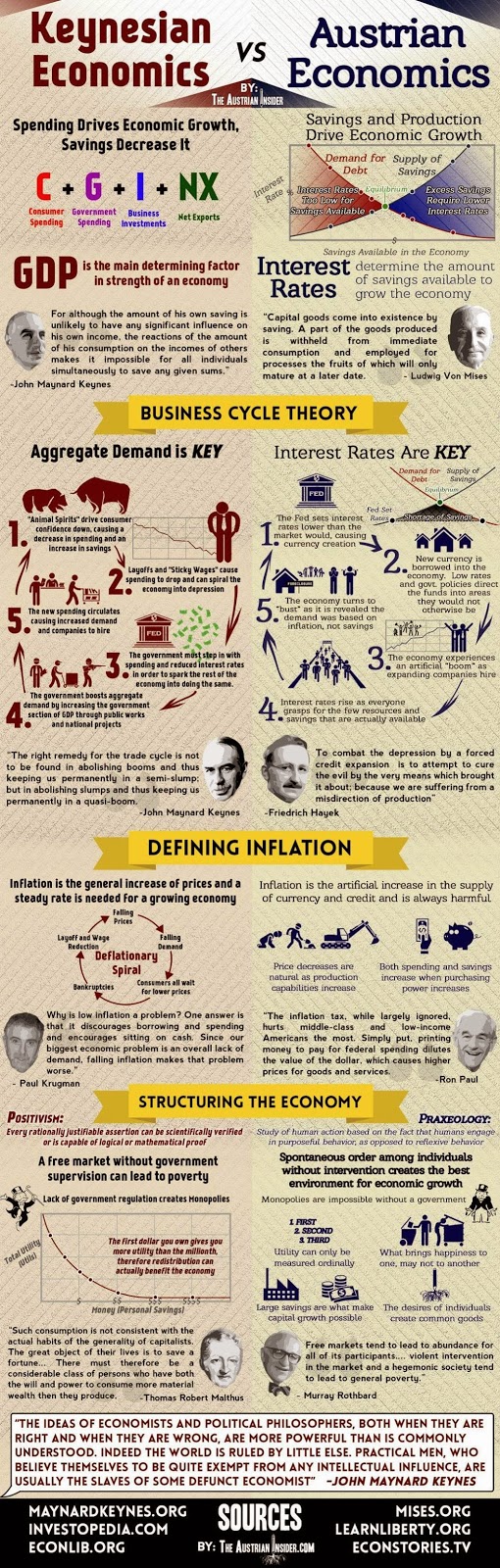
INFOGRAPHIC: Keynesian Economics vs. Austrian Economics:

Posted December 12, 2014 by austrianaddict
Categories: Econ. 201

Tags: , , , , ,

This infographic is from The Austrian Insider (click here). It gives a short outline of the differences between Keynesian Economics and Austrian Economics.


I’ve previously posted these two rap videos about Keynesian Economics vs The Austrian School, featuring F.A. Hayek vs. J.M. Keynes. Listen closely to the arguments from both sides, I forgot how well these were put together.
FEAR THE BOOM AND BUST: KEYNES vs. HAYEK
 
 THE FIGHT OF THE CENTURY: KEYNES vs. HAYEK ROUND II
These are by John Papola and Russ Roberts from Econ Stories.
Go to The Ludwig von Mises Institute at mises.org for more information about the Austrian perspective.